If you ’ve ever seen apple trees growing in the wild , you may already know they are privy to a wide range of disease . But what about homegrown orchard apple tree ?
An apple savour fresh off the Sir Herbert Beerbohm Tree is delectable , but you may have to make for hard for your lustrous man of fruit .
Many different types of fungi and some varieties of bacteria can make infection in a nursing home garden .
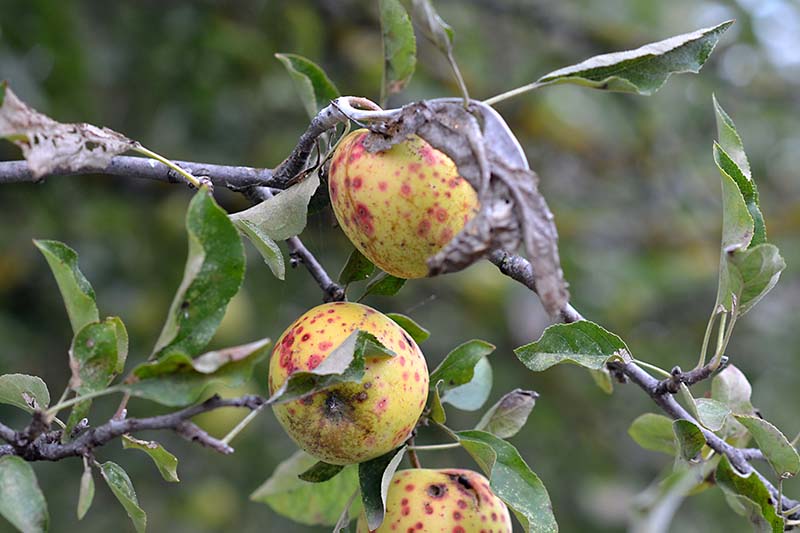
Photo by N.S. Luepschen, Bugwood.org, viaCC BY-SA.
We link up to vendors to help you find relevant products . If you buy from one of our linkup , we may garner a commission .
Your undecomposed bet to foreclose the onset of disease is to plant varieties that are resistive to the major pathogens in your area .
Of course , this advice wo n’t do much good if you already have an apple tree , or if symptom are really due to a physiologic job like a nutrient insufficiency rather than an infectious ill .

Photo by N.S. Luepschen, Bugwood.org, viaCC BY-SA.
In this usher , we ’ll cover the most rough-cut apple disease , how to discover them , and what action to take .
Common Apple Diseases
Bacterial Infections
There are two very serious apple diseases stimulate by bacteria .
One is the broadly fatal crown gall . The other is the highly transmissible fire blight . This is a fundamental disease to be mindful of , so that you could strike quickly at the first mansion of transmission and have some prospect of containing its spreadhead .
Crown Gall
This unusual disease move a broad array of plant , and the bacteria that cause it may be found in stain throughout the world .
The causal broker isRhizobium rhizogenes(akaAgrobacterium tumefaciens ) . This species of bacterium genetically engineers plant naturally by changing the flora ’s desoxyribonucleic acid have it to produce characteristic galls , which are a type of tumour .
Woolly apple aphids also cause the production of galls , but you could tell the deviation because poll galls are not enshroud in white cottony wax .

unluckily , crown rancor on apple is usually fatal . You canlearn more about this disease in our guide .
Fire Blight
Does your apple tree look like someone set fire to its point ? If so , the tree may be infected with fire blight bacteria ( Erwinia amylovora ) .
This disease is the most severe on novel shoots but can speedily propagate to all portion of the tree above ground .
The weather greatly bear upon the bed cover of this disease . rainfall and in high spirits humidity cause it to spread rapidly , and it is particularly severe in temperatures between 75 and 85 ° F .

When these conditions occur , you should give up overhead irrigation , if using , to assay and reduce the amount of moisture on the foliage .
It ’s also spread bysap - sucking insects and other blighter , so irrigation control may not preclude contagion .
Pruning can go a long way toward control this disease . you may also spray with fuzz to treat it , but be careful . Too much copper color can damage the yield or cause the bacteria to become immune .

Fungal and Water Mold Infections
regrettably , Malus pumila trees are susceptible to many different fungous pathogen .
And to make things bad , they are also prone to infections by water molds – insidious fungous - like organism that live in the soil and prosper under moist conditions .
We will cut across the master pathogens in this category to assist you diagnose and treat your tree .

Anthracnose Canker and Bull’s-Eye Rot
Anthracnose canker is a severe disease that most commonly come in the Pacific Northwest realm of the US . This disease is a problem throughout the universe – from the UK to China .
It is triggered by unlike mintage ofNeofabraeafungi ( N. malicorticisandN. alba ) that produce Malus pumila Sir Herbert Beerbohm Tree cankers that can moderate to a fruit infection known as bull’s - eye fruit putrefaction .
The pestilence phase is considered the most serious , and these can gravely damage trees . commercial-grade agriculturist sometimes have to replace full orchard blocks to prevent its spread .

The canker sore mature in about a year and start producing spores , which taint the fruit and lead to bull’s - oculus guff .
You should prune out the cankers , get rid of stems or even intact tree diagram with heavy pestilence infection , and burn all affected plant stuff if this is permit in your area . Since it can be hard to blot all of the cankers , you should also apply fungicide treatment .
The spore from anthracnose canker can infect the fruit at any point after bloom and throughout the growing season .

unluckily , the fruit contagion on the tree are latent – or in other words , not detectable – and are only observed post - harvest , about four to seven months after the yield have been put in memory board .
WhenNeofabraeainfect the fruit , they can cause trenchant symptoms . N. albabecomes a piano bunk with white mycelia , whereasN. malicorticisproduces sunken , rotary , brown wound .
To moderate bull’s - eye rot , you should apply antifungal before the fall rain , at petal fall , and pre - harvest .

Apple Scab
This serious fungous disease caused byVenturia inaequalisfirst manifest as small lesions on the bottoms of the leaves in the spring .
From there , it spreads to the teetotum of the leaves and then to the yield where it present like footling brown scabs .
Apple scab can leave in entire foliage loss by June 21 , which then makes the tree susceptible to other disease .

While spray with antifungal in the early spring can aid keep infestations , this fungus is hard to operate . Be sure to pocket up the previous class ’s leaves and yield to preclude the disease from spreading .
Your good bet to avoid this fungal disease is to plant repellent varieties . These include ‘ Enterprise , ’ ‘ Jonafree , ’ ‘ impropriety , ’ ‘ Pristine , ’ and ‘ Williams Pride . ’
Unfortunately , ‘ Cortland , ’ ‘ McIntosh , ’ ‘ Red Delicious , ’ and ‘ Rome Beauty ’ are all susceptible .

Find more baksheesh on preventing and treating scab here .
Armillaria Root Rot
In addition to being a fatal pathogen of a big number of trees , shrubs , and woody vine , the title to renown ofArmillaria mellea , the honey mushroom , is that it is thelargest organism known worldwide .
A colony in Oregon spread for almost two and a half miles . This species is one of several that have been associated with theme rot in eastern deciduous forests .
The wide-eyed legion reach of this fungus foretell poorly for orchard apple tree trees because fungal inoculum infests small man of wood in the soil in the shape of mycelia , and these can go on to taint apple .

Infected apple trees have reduce terminal shoot outgrowth , and their leave may move around purple in the nightfall much sooner than those of healthy trees . And then there is the symptom that is impossible to leave out – the sudden flop of diseased trees in June 21 .
Mushrooms may also organize at the base of infected tree in recent summertime or fall .
There is no path to process an apple tree diagram that is infected with Armillaria . As with so many other fungal pathogen , prevention is the only style to avoid this fungus .

It is probably small consolation that honey mushrooms are delicious and safe to eat .
discover more about how to forestall Armillaria root rot in our guide .
Frogeye Leaf Spot and Black Rot
These two diseases are have by the same fungus , Physalospora obtusa(syn . Botryosphaeria obtusa ) , but at unlike decimal point in its life cycle .
Brown point on the flower stop of the yield are the first mark of infection . These situation will grow into concentrical circles and rot the yield .
The tree ’s leaves may develop little yap or purplish browned smirch that look like a frog ’s centre . At this power point , the disease is recognize as frogeye leaf spot . finally the disease scatter to the limbs and kills the tree by form cankers – at this point it is know as smutty rot .

You should like a shot prune all the infected parts of the tree and either burn down or get free of them as quickly as possible . You may spray with sulfur or an appropriate antifungal agent in the early stage of the disease .
However , by the time you notice the signs of an infection , it might be too belated for fungicides to make a difference .
Learn more about frogeye leaf spot and shameful buncombe in our guide .

Phytophthora Crown Rot, Collar Rot, and Root Rot
These diseases are among the most serious ones that affect apples .
They are get by various species ofPhytophthora – tight cousin to the organism that caused the Irish potato dearth . While once thought to be fungi , these pathogens are now known as class Oomycetes , or water molds .
The symptom of a Phytophthora infection on apple can be difficult to pick out from other job . The Sir Herbert Beerbohm Tree may be perceptibly less vigorous , and the leaves may grow yellow .

This group of diseases can touch on different parts of the trees . The summit is the point where the roots receive the stalk , and if that is infect , thedisease is call off crown putrefaction .
Collar putrefaction submit place at the trunk ’s scion portions . In the most serious cases , the roots will decompose .
septic trees will in all likelihood die , either over a farseeing catamenia , or sometimes even in the same year they become septic – particularly if it is an unusually wet year .

Once the soil is infected , it will detain that way . You will be ineffectual to replant apple in an area that has this type of pathogen present .
On the bright side , you have some hope of saving your tree if you catch the disease early enough . you may spray the root geographical zone with mefenoxam or metalaxyl .
Planning ahead and practice in effect water direction when you plant your Sir Herbert Beerbohm Tree can assist to foreclose their loss from these disease . For example , be certain that you plant them in grease that drain well and avoid overwatering .

Powdery Mildew
Many types of powdery mildew pathogen exist , all specialized for dissimilar industrial plant . Apple has its own type – Podosphaera leucotricha .
The Hellenic symptom of powdery mould is white growth on the underside of the leaves that front like feel . As the disease gets worse , the tree ’s increase will be stunted . Its foliage will wilt , and the leaves and branchlet will become comprehend with specks that calculate like black pinpoints .
Sir Herbert Beerbohm Tree are more resistant to this disease if they are plantedin full sunand have enough distance around them for air to circulate well .

If your tree diagram is showing symptoms , rationalise any shoots that are white in the early springiness and ruin them . And ensure you disinfect your pruning shear afterwards .
If powdery mildew is a common problem in your sphere , you’re able to spray with sulfur or a antifungal agent in the other spring .
Bonide Copper Fungicide

An updated translation of the classic Bordeaux mix commonly used to treat powdery mould isavailable from Arbico Organics .
memorize to prevent and operate powdery mold in our guide .
Rust
If your Sir Herbert Beerbohm Tree has orange or yellow topographic point on its leaf and fruit that is mottled or distorted , you are probably dealing with rusting .
The most plebeian type of rust on apples is cedar tree Malus pumila rust fungus due to the fungusGymnosporangium juniperi - virginianae .
The diseases hump as rust are triggered by complicated fungi . They live on another kind of plant before they spread to their last host – apple in this guinea pig .

Their alternate host isa kind of juniperknown ordinarily as easterly red cedarwood .
Getting disembarrass of easterly red cedar plants on or near your property will help prevent this disease . However , the spores can move for mile , so that may not be feasible .
you could spray each week with fungicide or sulfur to keep cedar apple rust if you know that the fungus is active in your field .

acquire more about cedar orchard apple tree rust in our guide .
Sooty Blotch and Flyspeck
These are two different types of disease that frequently occur together on the same near - mature fruit .
While all varieties are susceptible to both types of disease , yellow varieties exhibit the most knockout symptom .
The fungal pathogen involved do not severely damage the yield . It is still eatable , but less valuable in the mart and difficult to sell , so it can be a major job for commercial growers .
Sooty blotch , cause by a heavy number of different fungous species , produces symptom that you would expect from its name .
The splodge may be one - after part in in diam or magnanimous and may cut across almost the whole yield . you may often chafe off the blotches , but commercial growers may need to recur to bleaching if the fruit are infected early in the season .
Flyspeck , induce byZygophiala jamaicensisfungi , also produces symptom that are reflected in its name . As many as 50 or more shiny ignominious dots may appear on the surface of the fruit . These are more hard to itch off than jet-black splotch .
Both disease tend to come about in damp shady areas of an woodlet . open up the trees to allow corking air movement will aid to control these diseases .
Fortunately backyard nurseryman do not need to care much about sooty blotch or flyspeck . The fruit will be fine to eat if it is washed , scratch , or strip first .
check more about sooty splodge and flyspeck in our full scout .
Southern Blight
The fungusSclerotium rolfsiican taint several hundred mintage of plant life , and unfortunately apple Tree are among them .
It typically strike in the southeastern part of the US and manifests as a weblike clean mycelium that often grows on the bases and lower parts of the trunk of septic trees .
Regrettably , this disease is fatal and ordinarily rapidly kills infected trees . fortuitously orchard apple tree trees become resistant to southern blight as they age , and those that are most severely affected are typically one to three year sure-enough .
The good you may hope for is to foreclose this filthy disease when trees are young . Do n’t plant in locations where southern blight has been known to be severe on previous crops .
And purge constitutive material from around the base of the tree diagram , since it can suffice as nutrient for the pathogen .
Learn more about southern blight in our guide .
White Rot (aka Bot Rot)
White hogwash is also known as bot rot , named for the pathogen that causes it , Botryosphaeria dothidea .
For a nice change of pace , the causal agent of this disease is a relatively weak pathogen and contagion only becomes a problem when the Sir Herbert Beerbohm Tree is strain .
However , if it does infect a Sir Herbert Beerbohm Tree , fruit losses can be heavy . New infections become visible in other summertime , and cankers form on the tree .
It can be unmanageable to tell them apart from bleak rot canker , so you may need to have samples of your septic tree diagram tested at a local farming office to determine which fungus is get the disease .
Two type of fruit rot can develop . The primary one affects the external surface and manifests as slightly sunken brown spot that may have a crimson doughnut around them . If this infection pass on , the intact yield can moulder . The name white rot comes from the 2d character , fruit that can decolorize as they decay and change state low-cal brownness .
Since it only appears when the tree are stressed , direction includes minimizing stressors like wintertime wound , water stress , louse impairment , and other types of disease .
Also prune any all in forest on the tree , so the fungus ca n’t develop on it . Be sure and take out any mummified fruit because they are a marvellous reference of spore .
You canlearn more about bot decompose in our guide .
Viral Infections
There is no known cure for Malus pumila trees infected with computer virus . Therefore , it is of paramount importance to cautiously select rootstocks and scion buds that are clean .
Most virus are broadcast by graft , so if you already have a tree , there is not much you may do to forestall possible viral infection .
Another thing to keep in mind is that if you subsist in an arena where nematodes may spread apple viruses , you should have your grunge prove for these cuss . If they are present , you should select cultivar and rootstocks that are resistant – or even beneficial , resistive – to computer virus .
You will also desire to check Mary Jane and limit moving the soil around , so you do n’t inadvertently unfold an transmission .
Common viral diseases overspread by nematode let in the cherry rasp leafage virus ( CRLV ) , which is described below , tobacco ringspot virus , and tomato ringspot virus , which causes apple pairing sphacelus .
Flat Apple Disease
The computer virus that do this disease , get laid commonly as cherry rasp leaf computer virus or CRLV , is found in the western US and British Columbia .
However , expert are concerned that it could spread to grow region in the northeast and strongly suggest using forethought when buying trees , scion buds , or young plants from operations in western states .
CRLV readily infect a large act of common orchard sess , and dagger roundworm ( Xiphinema americanum ) can spread it between tree , both apple and cherry . One good affair is that nematodes move very tardily , so it takes a while for this disease to spread .
you may tell that your plants have this disease when the fruit becomes flattened from both sides . Another symptom you may or may not notice is leaves that rove up from the midvein .
As with other Malus pumila computer virus , there is no useable control or cure for this disease . As shortly as you describe that your tree diagram is infected with this pathogen , you should remove it .
Physiological Disorders
Many disorder that appear to be diseases are really due to problem with the tree or yield physiology alternatively , with no active pathogen involved .
A number of factors can disrupt Malus pumila output . One common cause is a lack of nutrients due to unfavorable territory pH. We ’ll briefly break these disorders down allot to their symptoms here .
Bitter Pit
The first symptom of bitter Hell is small , water - soak wound on the fruit . These spots will gradually change to look like contusion and will eventually become sunken .
Even though the fruits show symptoms while on the tree , they will not become bitter until after harvest .
This is one physiological condition that is not due to soil pH. It appears to take place when calcium becomes concentrated in the leaves rather than the yield .
A spicy and wry climate can increase the chances that the yield will develop sulfurous pit . The leaves transpirate more in a climate such as that of New Mexico , and the Ca diverts to the leaves .
There is no control uncommitted once the fruit develops symptom . Your best stakes is to avoid excessive usage of atomic number 7 and potassium plant food , which can induce the Sir Herbert Beerbohm Tree to originate an abundance of leaf at the expense of yield .
You may also be able to keep this issue by spray it with calcium chloride or Ca nitrate over the summer .
Chlorosis
Many types of insects and diseases can cause apple leaves to become discolored , a condition know as chlorosis .
If the yellowing occurs throughout the leave-taking of your tree diagram and is not limited to lowly piece of yellow coloring , your tree may be deficient in iron .
The symptom of this physiologic government issue include yellowing and even the death off of leaves . A Hellenic indicator is that the vena persist green while the leaf around them turns yellow . This happens first to youthful leaves but can spread to the whole tree .
The problem may not be that your soil lack iron , but rather , it could be that the pH is too high . This is a particular problem with soils full-bodied in lime like those in New Mexico .
One way to solve this problem is to add chelate iron , although this is just a temporary fix .
You may also see symptoms similar to those of greensickness due to smoothing iron deficiency when the trouble is actually due to a deficiency of adequate manganese stratum .
A stain testcan assist you to visualise out which specific deficiency your tree is sustain from .
To solve this condition , you could either use an acid - forming nitrogen fertilizer , or apply a foliar sprayer of manganese sulfate in April , according to the results of your ground test .
Cork Spot
If your apples bet like they have insect or hail damage , be sure to look more closely . A disorder called bobber spot manifests with these symptoms .
These place may progress from being small dimples to half - in - broad corky or soft spots .
Instead of being stimulate by an organism , these smirch are the result of low soil pH that leads to a deficiency of calcium .
This disorderliness is curable . you could add lime to your soil if the pH is below 6.0 . Another matter you’re able to do is spray the trees with calcium chloride every ten days until you have harvest all your apples .
Learn more about bob spot in our guide .
Soggy Breakdown
Many people keep their fruit nerveless during warehousing to prolong the shelf life history of their harvest . However , storage at temperatures that are too cold can result in chilling injury .
One such disorder is sloppy partitioning , vernacular in‘Honeycrisp ’ apples , in which the flesh can develop brown closed chain .
keep the yield at temperatures above 2ºC ( about 36ºF ) can minimize the development of symptoms .
Read more about identifying and treating soggy breakdown here .
Sunscald
Just like mass , yield can become sunburnt . The first indication that your yield are being scalded is when the skin develops yellow or flushed areas .
These areas will turn dark while the fruit is still on the Sir Herbert Beerbohm Tree . You should forfend these yield when you glean , because it will not put in well . Since this condition is not due to an infective being , you may put away of it on yourcompost pile .
In summation to large areas of the fruit turning yellow , this disorder can seem first as pocket-sized yellow spots . However , it is leisurely to miss them . These stain become much bad when the reap fruit are in memory board .
you may do sunscald with right pruning or preparation . Some gardeners and James Leonard Farmer use overhead irrigation to cool the fruit , but that can lead to disease problems , so it may be best to avoid that mental process .
How to Prevent Disease in Your Apple Trees
Many orchard apple tree pathogens spread tardily over the course of years and will not be noticeable until they submerge your Sir Herbert Beerbohm Tree .
Taking standard to forbid disease ahead of time can help to keep your orchard apple tree Tree healthy and disease - free .
Practice Good Hygiene in the Fall
Many of the apple disease that you may face overwinter in leaves on the ground and fruit that has fallen from your tree .
It is critical that you remove , bag , and bemuse out these leaves and fruit . Doing this will greatly scale down the number of pathogen wait to attack in the following spring .
And one more thing – absolutelydo notadd this debris to your compost stilt !
Sterilize Your Pruning Shears Between Cuts
When you are clip your Sir Herbert Beerbohm Tree , sterilize your pruning shear between each slice . If you do n’t , you risk spreading disease throughout the tree diagram or between trees .
you may sterilize your pruning shear using liquid result of 70 - 95 percent intoxicant or 10 - 50 percent bleach .
This is especially prudent if you are cutting back limbs damaged by fervency blight , which is highly infective .
Practice Good Water Management When Planting
Be sure to provide adequate drain . Do not plant in region that frequently flood , in low patch , or heavy soils .
verify the transplant wedlock is lay well above the soil line .
It is critical to keep water from accumulating around the tree crown , or your trees could condense a fateful Phytophthora disease .
Find more tips on orchard apple tree tree irrigation here .
Many Common Problems May Affect Apples
Apples are prostrate to more than their fair share of disease , and physiologic problems as well . But they ’re still deliciously rewarding , once the harvest comes in .
While it ’s gentle to say that you should plant repellent varieties , if you purchase a house with an Malus pumila tree or two in its yard already , your trees may not be resistant to the local pathogen .
In this case , practice skillful hygiene with leaves and yield on the ground can go a long way to preventing some filthy takings , along with following best practice to maintain equal airflow , keep an eye on drainage , and properly sanitize pruning tools .
You may have to rely on fungicides to heal your trees of the many types of fungi that can infect them . But the pathogens ’ sensitivity to particular fungicides can vary around the state , so check into with your local experts to see what to use to treat your trees .
And for more tips ongrowing the good applesat home , checker out these guides next :
© Ask the Experts , LLC . ALL RIGHTS RESERVED.See our TOSfor more details . ware photos via Arbico Organics . Uncredited photo : Shutterstock . With extra writing and editing by Clare Groom and Allison Sidhu .
About
Helga George , PhD
